top of page

Search


The South China Morning Post: As the American century ends, Asia’s renaissance begins
The businesses that adapt early to engage China, India and Asean will help draft Asia’s next chapter and profit from it Kishore MahbubaniandSteven Okun Published: 4:30pm, 15 Sep 2026Updated: 5:21pm, 15 Sep 2026 The ending of the American century is coinciding with an Asian renaissance. America remains the world’s largest economy and will stay that way for another decade or two. But its economy no longer dominates the world. And its “America first” policy has partners and alli


US-ABC: U.S. ASEAN Strategic Business Forum
As the American century fades, the Asian renaissance begins. Kishore Mahbubani sat down with our CEO Steven Okun for a fireside chat at the US-ASEAN Business Council's Strategic Business Forum. ASEAN isn't westernizing it's modernizing, on its own terms, shaped for centuries by deep cultural ties to the two giants on its borders, India and China. An image for how the region moves is like a crab: sideways, sometimes backwards, sometimes forwards - never in a straight line, bu


The Nanson Geopolitical Series: Trump 2.0
Forget the usual swing voters. The “precariat” is the new voting base shaping the midterms. They're those living with chronic insecurity - unstable work, unpredictable income and few of the safety nets once taken for granted. As part of Steven Okun’s Geopolitical Series at The Nanson, we explored what could shape the midterms and US-China relations, in discussion with Deborah Elms, Damien Ma and Sonal Varma. This insecurity cuts across the US political and economic landscape.


AmChamSG Regional Economic Conference: The Imperative for Business to Adapt to Changing Geopolitics
At the The American Chamber of Commerce in Singapore (AmCham Singapore)'s Regional Economic Conference, our CEO Steven Okun and Manager Noemie Viterale led Workshop 3: The Imperative for Business to Adapt to Changing Geopolitics. The session covered how public affairs is changing for U.S.-headquartered companies and those doing business with the U.S., where new opportunities are emerging, and why companies need to play the long game. A recurring thread throughout: resilience


Bloomberg: Trump's $5000 Payout Promise Underscores GOP Midterm Peril
President Donald Trump offered voters a quid pro quo, saying elect Republicans and get a $5,000 payout, which he called the Trump dividend. Trump's announcement was met with skepticism, with some seeing it as a desperate attempt to motivate voters and others predicting it will backfire, particularly given the US debt at record levels. “Independents and swing voters will see this as a ploy and not a solution to the their affordability problems. That’s why this will backfire,”


The Global Private Capital Association: Women as the Opportunity: Building Stronger Funds in Southeast Asia
APAC Advisors is proud to have supported the third annual "Women as the Opportunity" training, delivered by the Global Private Capital Association (GPCA) in partnership with Investing in Women and FMO - Dutch entrepreneurial development bank. Steven Okun, Senior Advisor to GPCA, and Noemie Viterale, Program Manager for GPCA's partnership with Investing in Women, helped lead the day's programming for more than 50 investors and fund managers from across Southeast Asia. The trai


BFM 89.9: The US & Canada Play Chicken
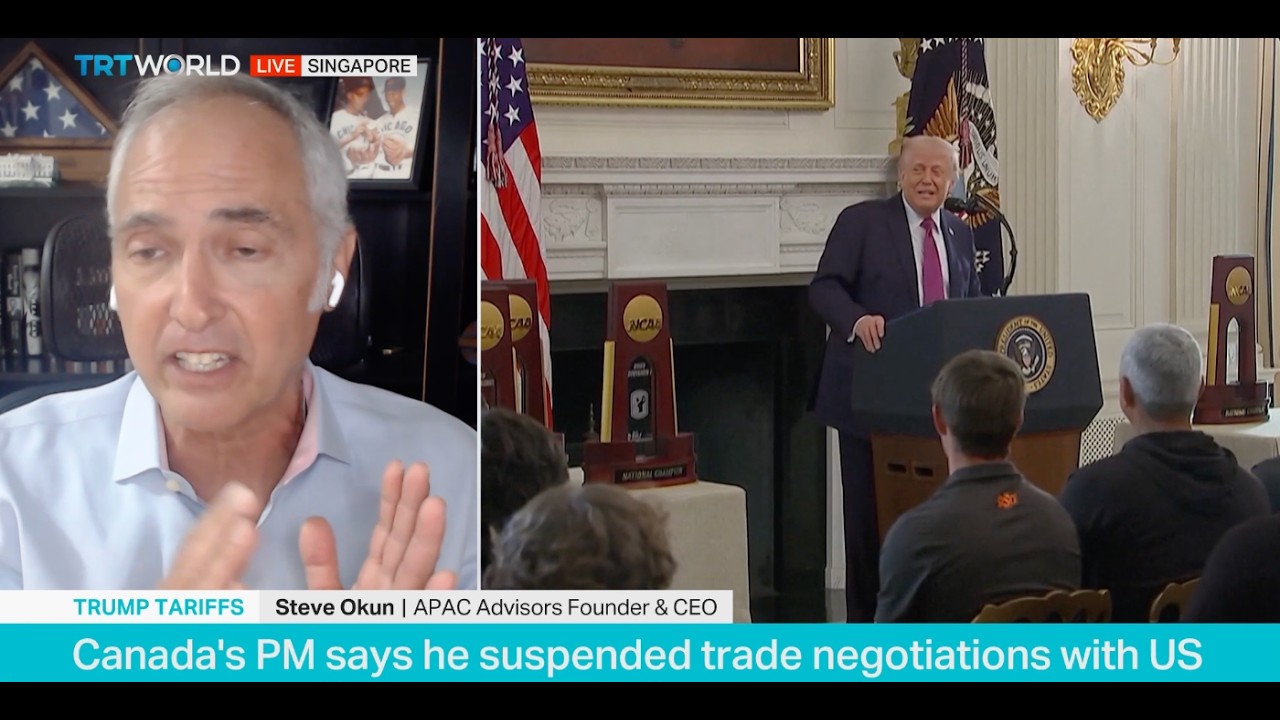
Guest: Steven Okun (CEO), APAC Advisors The US and Canada have one of the world's most deeply integrated trading relationships, but tariff threats and tensions over sovereignty have pushed the two neighbours into an escalating trade war. Steven Okun, Founder & CEO of APAC Advisors, discusses how the negotiations broke down and what this means for the future of USMCA and the world.


The British Chamber of Commerce in Singapore: Geopolitics Committee Launch
This year BritCham launched a new Geopolitics Committee, meeting every few months and reaching out when major events take a turn that impacts our members. Steven Okun shared his thoughts on current US developments, and H.E Nikesh Mehta brought the UK perspectives, and dug into economic diplomacy and shifting world orders.


APAC Advisors Geopolitical Roundtable Series: Derek Grossman
Deprioritization of Indian Ocean; All-In at First Island Chain That's Derek Grossman described the US' foreign policy from a South Asia perspective following his four-nation tour of the Indian Ocean Region at the latest in the APAC Advisors (Singapore) geopolitical series. Start with the premise that the "Indo-Pacific" was never more than an organizing concept for the US to counter China that held from Obama through Trump 1.0 through Biden. The US’ new mechanism is to push al
Eco-Business: Don’t wait on a responsible AI policy. You already have one
Artificial Intelligence’s environmental, workforce, consumer and governance risks already belong in existing risk and disclosure systems. Companies waiting on a Responsible AI policy are ignoring the obvious. By Steven Okun and Megan Willis, Noemie Viterale Companies exempting artificial intelligence (AI) from their existing governance system take a great and unnecessary risk in doing so. As companies race to integrate AI across their operations, they do so with the twin goal


The Nanson Book launch: The Man Who Stole the Gods
Steven Okun sat down to interview Matthew Campbell on his new book.


The Business Times: Reframing ‘Brand Singapore’ for an ‘America First’ era needs business support
The most credible messengers are the companies and investors who profit from the Republic’s success every day For decades, the US prized partners that upheld the rule of law, kept markets open and met high standards on trade and investment – making Singapore the natural choice for its first Asian free trade agreement partner. Singapore’s values and commitments to the US have not changed.\ For the US, that calculus has shifted as those values are not priorities of an “America


Eco-Business: 𝗧𝗿𝗮𝗻𝘀𝗶𝘁𝗶𝗼𝗻 𝘂𝗻𝗱𝗲𝗿 𝗽𝗿𝗲𝘀𝘀𝘂𝗿𝗲: 𝗛𝗼𝘄 𝗴𝗲𝗼𝗽𝗼𝗹𝗶𝘁𝗶𝗰𝘀 𝗶𝘀 𝘀𝗵𝗮𝗽𝗶𝗻𝗴 𝗔𝘀𝗶𝗮’𝘀 𝗰𝗹𝗲𝗮𝗻 𝗲𝗻𝗲𝗿𝗴𝘆 𝗳𝘂𝘁𝘂𝗿𝗲
Asia is simultaneously racing to decarbonise and navigating some of the most volatile geopolitics in decades. The ongoing Gulf conflict has exposed the vulnerabilities of the region’s energy system, by way of import dependence, limited fuel diversification and concentrated supply routes, compounding existing pressures from grid bottlenecks, regulatory uncertainty and weak investment signals. Yet, the transition remains underway. Renewable energy capacity continues to expand,


The Hinrich Foundation: Trade won Trump the White House. It could lose him Congress.
Trade, once central to Donald Trump’s political rise, could turn against him and the Republican Party in the 2026 midterms. Tariffs, the war with Iran, and uncertainty over USMCA are moving trade front and center this year, especially in trade-exposed states, potentially helping Democrats reclaim the House and possibly the Senate. Steven Okun and Noemie Viterale “It’s the economy, stupid,” a phrase from Bill Clinton’s winning 1992 Presidential campaign, epitomizes how economi

The National Press Foundation: The Gathering Geo-Political Storm – What the U.S. Mid-term Elections Could Mean for Asia and Trade
Current U.S. politics, foreign policy, and global trade dynamics intersect to create complex international ramifications. Steven Okun, founder and CEO of APAC Advisors Singapore, discussed how the fragmentation of global trade is reshaping Asia’s economic and geopolitical landscape.


Lianhe Zaobao 联合早报:
International Feature: Trump's Family Wealth Soars During His Second Term, Raising Concerns About Using Public Power for Private Gain President Trump's wealth has skyrocketed during his second term, with his companies making numerous overseas investments, sparking a storm of speculation. Although he claims his businesses are now managed by his son, the overlap between policy-making and family interests renders the US's political recusal mechanisms ineffective. When public pow


The Straits Times: Could Michelle Obama run for US president in 2028?
The Democratic Party bench is deep and an answer to who its nominee is won’t emerge until much later. Steven R. Okun and Thurgood Marshall Jr Published Jun 27, 2026, 05:00 AM Last week, former US first lady Michelle Obama took the stage at the Obama Presidential Library – and within hours, speculation began once more about whether she might finally enter the race for US president. It is a ritual by now. Each rare occasion she gives a speech, Democrats swoon. Few people connec


Eco-Business: AI's Societal Risks Make Governance a Business-Wide Challenge
As featured in Eco-Business, June 24, 2026 AI governance is no longer a technology department problem. It's a boardroom imperative — and most companies aren't treating it that way. That's the view Steve Okun, Founder and CEO of APAC Advisors, shared in a recent Eco-Business feature on AI's mounting societal risks in Singapore. His core argument: the risks AI brings cut across every geography, sector, and stakeholder group, and nearly every business now plays a role in shaping
bottom of page