top of page

Media
Steve regularly appears on global media including CNBC, Channel News Asia, Al Jazeera and ABC Australia, as well as providing a weekly International News Review segment for MONEY FM. He also writes regularly for The Straits Times, The Nikkei, Eco-Business and other media outlets.


The Straits Times: Could Michelle Obama run for US president in 2028?
The Democratic Party bench is deep and an answer to who its nominee is won’t emerge until much later. Steven R. Okun and Thurgood Marshall Jr Published Jun 27, 2026, 05:00 AM Last week, former US first lady Michelle Obama took the stage at the Obama Presidential Library – and within hours, speculation began once more about whether she might finally enter the race for US president. It is a ritual by now. Each rare occasion she gives a speech, Democrats swoon. Few people connec


Eco-Business: AI's Societal Risks Make Governance a Business-Wide Challenge
As featured in Eco-Business, June 24, 2026 AI governance is no longer a technology department problem. It's a boardroom imperative — and most companies aren't treating it that way. That's the view Steve Okun, Founder and CEO of APAC Advisors, shared in a recent Eco-Business feature on AI's mounting societal risks in Singapore. His core argument: the risks AI brings cut across every geography, sector, and stakeholder group, and nearly every business now plays a role in shaping


The National Press Foundation
Journalism in a World of Obsolete Geopolitical Assumptions There is no "trade truce" between the US and China. That was Steve Okun's opening line — and he meant every word of it. Steve returned for his annual session with the National Press Foundation's International Trade Reporting Fellowship, speaking to 25 journalists from across Asia on geopolitics and trade. The message was clear: too many stories are still being told through a lens that no longer reflects reality. Three


The Guardian: ‘Compound shock effect’: why the Middle East crisis and El Niño could spell disaster in south-east Asia
Why does this matter so much for Asian economies? The closure of the strait of Hormuz provided a “stark wake-up call” exposing the region’s vulnerability, according to a report released by the International Energy Agency (IEA) last week. Before the crisis, 60% of south-east Asia’s imports of crude oil and a third of its imports of gas came from the Middle East, according to the IEA. The region’s energy import bill is projected to reach $160bn this year – double the $80bn bill


South China Morning Post: Many countries are ‘quiet quitting’ the US and China on trade
While the US and Chinese markets are essential, other countries are making deals with each other in search of more diversified trade Steven Okun and Kellie Meiman Hock Published: 8:30pm, 18 Jun 2026 As US President Donald Trump rebuilds the tariff wall the country’s Supreme Court knocked down, the headlines fixate on each individual block. With the global 10 per cent tariff initially levied in response expiring on July 24, the Trump administration is preparing to replace it b


CNBC Inside India: Iran-U.S. deal may not remain good news over the long term
Steven Okun, CEO of APAC Advisors, joined Sri Jegarajah on CNBC's Inside India to break down what the U.S.-Iran MOU means for energy markets, trade routes, and investors across the region. The U.S.-Iran ceasefire MOU is good news for the short term — oil prices ease, markets respond, and countries like India, South Korea, and Thailand get some relief. But the bigger question is what comes next. Freedom of navigation through the Strait of Hormuz was once absolute; that certain
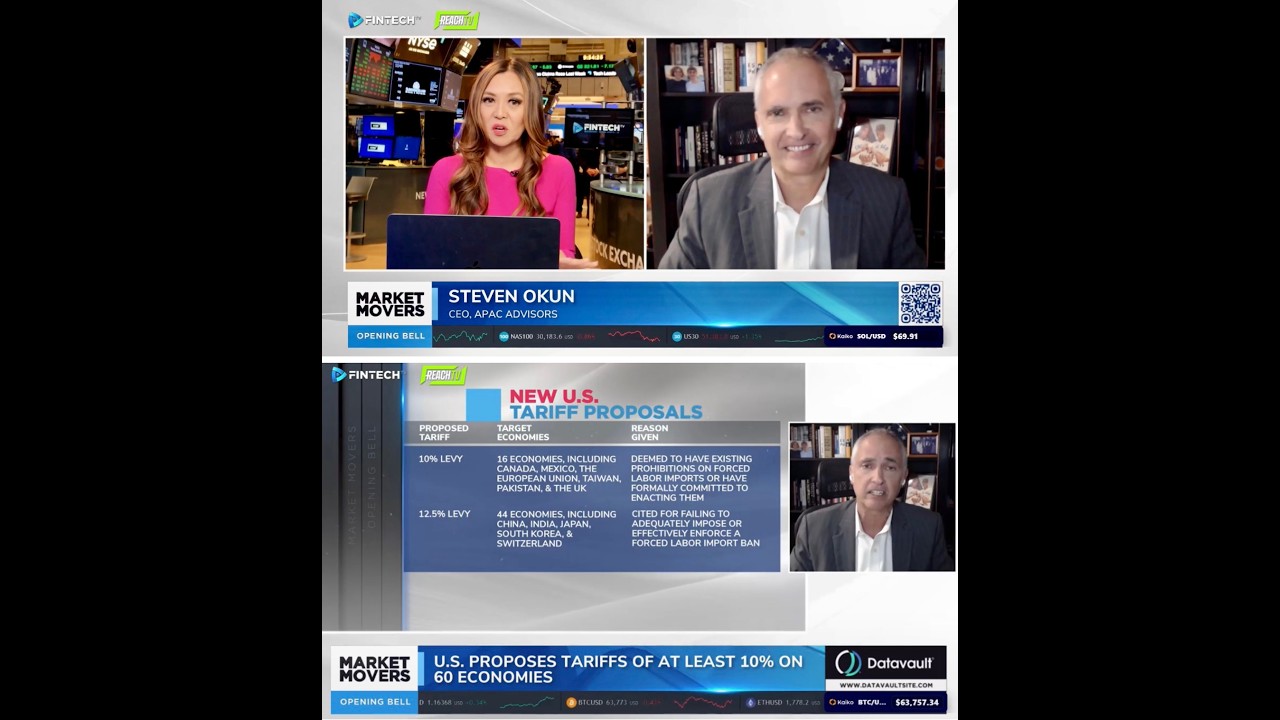

Market Movers for FINTECH.TV: Tariffs, Iran and the US-China Trade War: Markets Don't Care, But Voters and Trading Partners Do
Trump rebuilds his tariff wall. The Strait of Hormuz remains closed. The US and China are at a stalemate. The markets continue to go up. Investors may be happy. But voters are not. Nor are the US’ trading partners. Republicans will pay the price at the voting booth. Long term, countries look to diversify away from both the US and China.


Mergermarket: Private equity’s slow start on AI governance
“People think AI is going to be like air, available for as long as they want and affordable enough for them to consume as much as they need," Steven Okun told Tim Burroughs as part of his deep dive on how private equity firms approach AI adoption. Many PE firms and their portfolio companies go all in on AI but with no budget, no risk plan, and no idea what happens if it gets expensive. What if AI costs 5x more in three years? Do you still hire that many fewer analysts? Becau


Al Jazeera: Is The West de-risking from China or containing its economy? | Counting the Cost
For decades, companies flocked to China for cheap manufacturing at scale and speed. Now, Western governments are pushing businesses to pull production and reduce their commitments. Beijing is hitting back with sweeping new rules that critics say could make it harder for foreign firms to diversify their supply chains. China says the measures are about protecting national and economic security - as it accuses the West of protectionism. The United States and Europe have been try


Nikkei Asia: In Asia, geopolitics has moved onto the deal sheet
Private equity firms can no longer treat government as a regulatory afterthought Steven Okun and Derek Grossman Steven Okun is CEO of APAC Advisors, a geostrategic consultancy based in Singapore. Derek Grossman is a professor of political science and international relations at the University of Southern California. Private equity and venture capital firms operating in Asia had one fewer significant constraint than counterparts in the U.S. -- they didn't need to worry about de


Vietnam Today: U.S. – China Summit Update
The eyes of the world have been fixed on Beijing this week, where what may be the most significant diplomatic recalibration of the decade is taking place. After all, it's the high-stakes summit between U.S. and China. As US President Donald Trump along with Chinese Party General Secretary and President Xi Jinping conclude their summit on 15 May, they have framed the U.S. – China bond as the most consequential in the world. Steven Okun speaks with Vietnam Today


Al Jazeera: US-China: Still in a Trade War, Still Adversaries
Steven Okun's analysis after day one of the Trump-Xi summit for Al Jazeera The Trump-Xi summit seems to be a success in that it has stabilized the relationship for now. But all of the core issues between the two countries remain. China's unfair trade practices all remain in place, and the US continues to work to isolate it from critical technology. And we will likely see the US increase tariffs on China in July when the US raises tariffs on countries such as Malaysia, Thailan
The New York Times: Trump's Trade War With China - How We Got to a Stalemate in 3 Numbers
Steve Okun, chief executive of APAC Advisors (Singapore), predicted the Trump administration would soon raise tariffs on China, potentially to 35 percent or more. Mr. Trump, he said, “will need to be careful not to commit to taking 301 off the table at the coming summit.” Why? As the US prepares to raise tariffs on much of the world through ARTs or Section 301 tariffs for forced labor or industrial capacity, China must be included. For example, Vietnam's tariffs will soon be


BBC: Southeast Asia and Taiwan Nervous as Trump Heads to Beijing
Tariffs are relative. Will Trump lower China’s tariffs to close to those planned for SE Asia when either the Agreements on Reciprocal Trade or the Section 301 tariffs kick-in, either by July 24 when 122 expires? The lower the differential on tariffs between China and countries like Malaysia, Thailand and Vietnam, the more likely companies which left China will return, reversing in part China +1.


Channel News Asia: White House dinner shooting raises questions about security measures
Authorities are investigating a prime suspect after a shooting at the White House correspondent's dinner in Washington DC. It's the latest in a series of violent episodes in US politics. Mr Steven Okun, CEO of APAC Advisors, shared more about the apparent attempt on US President Donald Trump's life and the typical security arrangements at such presidential events.


Eco-Business: AI access may not always be unlimited as ESG risks mount – are businesses ready?
Companies need to stress-test their plans to ensure business continuity in a disrupted world where access to Artificial Intelligence could be scarce or expensive. By Steven Okun, Megan Willis, Noemie Viterale Businesses are placing massive bets on Artificial Intelligence (AI) on the assumption the investment will surely pay off. Their leaders’ decision making conflates AI with clean air – always available, in whatever quantity and quality their business needs. Businesses and


The Business Times: Despite ceasefire in Iran, businesses should follow Singapore’s model
Whether the ceasefire holds or not, firms should not assume business as usual Steven R Okun Published Wed, Apr 8, 2026 · 02:19 PM US PRESIDENT Donald Trump did not follow through on his threat to end a whole civilisation in Iran. Markets went up as a result. This does not mean long-term geopolitical risk and realignment will no longer occur. Trump remains President. While he sits in the Oval Office and the Iranian Republican Guard Corps rules in Teheran, fuel prices higher th


ABC News: China resilient amid global energy crisis | Asia News Week
With its shift towards green energy in recent years, China remains in good stead to weather the crisis that is gripping the world as the war in the Middle East continues. Steven Okun, CEO of APAC Advisors tells Asia News Week's Yvonne Yong why China is "basically doing better than anyone else in the region."


Global Insight for Vietnam Today: Global energy disruption from the Middle East crisis | Global Insight
In this episode of Global Insight, we examine the forces shaping our world. Escalating violence in the Middle East has pushed oil prices to a four-year high and shaken global markets, forcing governments to scramble for ways to stabilize supplies. Steven Okun spoke with Vietnam Today, stating that the war ends when Iran stops fighting, not when Trump declares victory. Trump declaring victory does not mean the war with Iran will be over. That will only occur when Iran stops fi


The New Gender Divide: Reflecting on Our International Women’s Day Webinar
In the spirit of International Women’s Day, we were pleased to host a timely and thought-provoking webinar exploring a critical question for today’s workforce: will artificial intelligence help propel women forward—or risk setting them back? Titled “The New Gender Divide: How AI Could Propel Women Forward – or Set Them Back,” the session brought together insightful perspectives from across APAC Advisors, featuring Senior Advisor for Responsible Investment Megan Willis, along


Eco-Business: AI can propel women forward - or set them back further
AI will mostly benefit those already well positioned to leverage it – men. Businesses and governments cannot afford to overlook gender as they invest in talent policies for the AI age. As Singapore celebrates early productivity gains from artificial intelligence, there’s a conversation about trade-offs that should also be taking place: who benefits, who falls behind, and what new divides may form. Without that discussion, women will bear the brunt of the costs of AI’s adoptio


Tank Talks Asia: Iran - What's at Stake? | Steve Okun & Sam Olsen
As tensions escalate between Iran, Israel and the United States, the implications stretch far beyond the Middle East. Energy markets, global trade routes and geopolitical alignments are all being tested — and Asia will feel the impact. In this special live episode, Manisha Tank is joined by: Steve Okun – CEO APAC Advisors, a specialist in US–Asia relations Sam Olsen – Geopolitical analyst focusing on global power dynamics Together they discuss: • What has happened in the l


CNBC: Following State of the Union, Asia Should Prepare for Even More Tariffs
Following the State of the Union, Asia should brace for another round of tariff pressure. President Trump made his continued reliance on tariffs unmistakably clear, even as earlier legal authorities have been curtailed. With emergency powers ruled unconstitutional, the shift toward alternative, time-tested trade statutes signals that tariffs are not going away —-they are being re-engineered. The next phase is likely to involve Section 122 in the near term, followed by a retur


The New York Times: Trump’s Supreme Court Loss Hits Hard on Countries Which Signed Deals
A US Supreme Court ruling has fundamentally shifted the economics of Trump-era tariff deals. With a uniform tariff rate now set at 15%, countries that agreed to higher rates — often alongside large investment commitments — now find themselves at a clear disadvantage. As reported by The New York Times , governments across Asia are reassessing whether moving quickly to secure deals was a strategic misstep, and whether those agreements will ultimately hold. As APAC Advisors CEO


Al Jazeera: Supreme Court Ruling Puts Countries That Signed Tariff Deals with Trump in a Bind
A US Supreme Court ruling has added fresh uncertainty for countries that struck tariff deals under Trump’s emergency authorities. In a recent interview with Al Jazeera English , APAC Advisors CEO Steven Okun unpacked what this means for countries such as Indonesia and Malaysia, now caught between legacy tariff commitments and a shifting legal landscape in Washington. With Trump’s emergency tariff powers curtailed and new tariffs time-limited, leverage dynamics have changed —


ABC: Is the EU–India trade agreement really “the Mother of Deals”?
In a recent ABC interview, APAC Advisors CEO Steven Okun unpacked why, under traditional FTA definitions, the answer is no — but why, in today’s fractured global trading system, that framing may be missing the bigger picture. With the rules-based order under strain, this deal could signal the emergence of a new trade architecture — one shaped without the U.S. or China as the primary architects. In that sense, it may well mark the beginning of something far bigger. Great to se


CNBC: US & China’s Matching Playbooks: Unpacking Trump in Davos
Trade is no longer just an economic tool — it’s a geopolitical weapon. In a recent CNBC segment, APAC Advisors CEO Steven Okun unpacked why the market relief following Trump’s Greenland tariff pause is likely temporary, and why the U.S. is increasingly mirroring China in weaponising trade. The implications for businesses are significant: greater uncertainty, higher risk, and a more politicised operating environment. As geopolitical playbooks converge, companies and investors


South China Morning Post Opinion | At 250, the US should promote its values in Asia, not spectacle
The star of America’s 250th anniversary celebrations in Asia should be its most enduring export – its founding principles Steven Okun Published: 5:30am, 27 Feb 2026 In his farewell address, then US president Ronald Reagan advocated for the United States to do “a better job of getting across that America is freedom: freedom of speech, freedom of religion, freedom of enterprise. And freedom is special and rare”. The Trump administration should follow Reagan’s advice as it desig


Singapore’s response to AI risks will fail unless businesses and investors follow
AI promises productivity gains, but without corporate and investor commitment, Singapore risks deeper inequality, higher emissions, and growing social strain as jobs are lost. By Steven Okun, Megan Willis, Noemie Viterale Feb. 20, 2026 Artificial Intelligence (AI) empowers businesses to do more with less people. Many businesses are racing ahead to take full advantage. DBS Bank’s announcement that AI will eliminate 4,000 jobs across 19 markets provides both a proof point and


Vietnam Television: Trump (Still) Does Not Believe in the Climate Crisis (Vietnam Television)
Trang (Tris) Ha Thao Nguyen invited Steve for an interview for the global affairs program Global Insight to forecast global clean energy momentum for the next 5 years and how this may be affected by changing climate policies from the US and China. The first question: What do you see as the main reasons behind US President Donald Trump’s climate stance? Simple. He does not believe in the climate crisis. And, a focus away from traditional energy sources would harm the US econ


The New York Times: In Beijing, Starmer and Xi Seek a Way Around a Volatile U.S.
A Hedge Against an Unpredictable United States Western middle powers like Britain, feeling increasingly alienated by the United States, are now looking to hedge their economic interests by rebalancing toward China, analysts said. “For the past few years, companies were diversifying and de-risking from China. Now, they are doing so from the United States,” said Steve Okun, head of APAC Advisors, a geopolitical consulting firm. Mr. Xi offered a thinly veiled critique of the cur


Commentary: Trump walking back Greenland threats offers little relief
The World Economic Forum meeting at Davos shows that the room for manoeuvre is narrowing for middle powers, says US politics observer Steven Okun. SINGAPORE: The end of this year’s World Economic Forum in Davos should not bring relief to anyone. Stocks rallied when United States President Donald Trump announced he would not use force to seize Greenland . However, the global economic order governments spent decades building, which markets benefited from, no longer exists. Sin


Eco-Business: How data centres can avoid becoming the next coal mines
The resistance to Artificial Intelligence will come from the social disruption it will bring – and data centres will be where that backlash lands first. Investors in AI must ensure that its benefits are shared across society, harm is reduced, and value created local Artificial intelligence (AI) fuels one of Asia’s fastest infrastructure expansions in decades – data centres, which are essential to achieve the promise of AI, such as advances in education, health care, longevity


Commentary: Fatal ICE shooting exposes how badly fractured America has become
Renee Good’s death could be a rallying point against President Donald Trump or a turning point towards a more authoritarian government, says US politics expert Steven Okun. SINGAPORE: The fatal shooting of Renee Nicole Good by a United States Immigration and Customs Enforcement (ICE) agent in Minneapolis last week has become tragedy and political flashpoint. Her death exposed just how badly the US has fractured. For one side, the killing of the unarmed 37-year-old mother of


Second-term Trump: Constrained at home, unchecked abroad
Domestic resistance grows as US president's foreign-policy latitude expands Steven R Okun and Thurgood Marshall Jr Steven R Okun and Thurgood Marshall Jr served in the Clinton administration as deputy general counsel at the Department of Transportation and White House Cabinet Secretary, respectively. Okun serves as CEO of APAC Advisors in Singapore. Marshall practices law in Washington. Even with his Houdini-like ability to escape consequences for actions once thought impossi


BBC News - Trump's Taiwan Twist: $300 Billion and Train Our Workers
Commerce Secretary Lutnick said the US expects a large investment pledge in excess of $300 billion from Taiwan in trade talks. Lutnick also said they would help train US workers for advanced semiconductor production. Taiwan maintains such training is not part of bilateral tariff negotiations. Just another example of America First where US treats its partners more as vassal states. Given Japan pledged to invest $550 billion and South Korea $350 billion, Taiwan got off light.


CNA Commentary: US ambassador's comments show how America First will play out for Singapore
The backlash to Dr Anjani Sinha’s remarks after beginning his tenure in Singapore shows just how difficult his mission will be, says political observer Steven R Okun. SINGAPORE: “Increase our economic and commercial ties,” was what President Donald Trump instructed Dr Anjani Sinha before he assumed the post, according to the newly arrived US Ambassador to Singapore . Yet the backlash to Dr Sinha’s recent remarks shows just how difficult that mission will be under Mr Trump’s A


The Quinntessential Questions Podcast with Paul Quinn
At a moment when business, politics, and global risk are converging, Steven Okun joined The Quinntessential Questions Podcast with Paul Quinn to explore what it really takes to lead in Asia. Steven reflects on how a journey that began on Bill Clinton’s campaign took him from Washington to Singapore - from opening China for UPS to helping shape the early foundations of ESG in Asia long before it became mainstream. The episode explores the biggest aviation case in U.S. hist


Eco-Business: Responsible investment’s AI trilemma – emissions, job losses and inequality
Investors who fail to assess and mitigate the potential harms of adopting Artificial Intelligence cannot credibly call themselves “responsible”. By Steven Okun, Megan Willis, Noemie Viterale Nov. 12, 2025 A hyperscaler data centre. For investors in AI, the test will be how to ensure adoption of AI while mitigating the harm from job losses, the increase in income inequality, and the damage to the environment. Image: Tommy Young/Flickr Artificial Intelligence (AI) did not exis


Decisions That Count Podcast: How One Decision Changed Travel Safety For Every Family With Steve Okun
The Unchecked Leader: Why Great Decisions Demand Checks, Balances, and Empathy — with Steve Okun When the stakes are high, one mind isn’t enough.In this episode of Decisions That Count , neuroscientist Dr. Shawn Watson and biotech CMO Michelle O’Brien sit down with Steven “Steve” Okun —ranked #2 on LinkedIn for Geopolitics & International Relations in Singapore (Favikon, July 2025)—to explore why the best leaders design decision systems : collaboration, diverse perspectiv


Mission Matters Podcast with Adam Torres
Geopolitics isn’t a backdrop anymore—it’s the arena. I talked with Steven Okun , CEO of APAC Advisors, to unpack the collision of business and government across Asia: America-first trade policy, the shift from multilateral to bilateral deals, tighter forced-labor enforcement, and why due diligence now requires “Sherlock-level” scrutiny. What you’ll learn: how policy shocks ripple through supply chains and capital flows, what investors and operators must do to stay compliant


Al Jazeera: Trump Heads to Asia: ASEAN, China, Malaysia/Transshipments, Rare Earths
Will ASEAN come together or fracture in dealing with America First? Can the US-China trade war stabalize? How will Chinese transshipments be addressed in a US-Malaysia agreement? Is there a coalition led by the US that can be developed to counter China's dominance of Rare Earth The only thing we know for sure: Malaysia, South Korea and Japan will each engage in "flattery diplomacy" given that's the playbook all governments use when it comes to Trump. Breaking down what to wa


The ‘Sleeper Issue’ at the Heart of Trump’s Trade War on China
Concern is increasing throughout Southeast Asia as U.S. officials, intent on slowing China, have yet to say how they will define the origin country of imports. Trump administration officials have been vocal about setting one rule-of-origin target for the region. They have focused on 30 percent: Any product containing more than that level of foreign parts or content sent to the United States would face the special transshipment tariff. While discussions are fluid, one thing is


Trump Opens Trip With Trade Deals in Southeast Asia
The U.S. announced agreements on Sunday with Malaysia, Thailand and Cambodia, securing support for its efforts to pressure China on trade and critical minerals. While the statements did not mention China, to varying degrees they signaled each country’s support for Mr. Trump’s aim to reduce China’s stranglehold on some of the most important materials that go into a wide array of products, such as batteries, smartphones and magnets for fighter jets. In addition, the statements


Think China: Trump’s Asia comeback: Peacemaker, power broker — or performer?
Steven Okun, CEO of public affairs consultancy APAC Advisors, said when interviewed that though Trump is not expected to make significant policy statements at the ASEAN Summit, his attendance itself sends an important signal that “Southeast Asia is key to the US from an economic perspective, a geopolitical perspective and a defence perspective.” “Just by taking off the fentanyl tariffs, that would put China at almost the same tariff rate as most Southeast Asian countries. And


CNA: Dr. Anjani Sinha Confirmed by Senate as US Ambassador to Singapore
Sinha Confirmed: Can Be Successful Ambassador to Singapore (Steven Okun's Analysis for CNA ) As U.S. Ambassador to Singapore, Anjani...


Al Jazeera: Will Trump's tariffs push China and India closer? | Counting the Cost
Their relationship has long been defined by rivalry, competing ambitions and a disputed border. Now, India and China are resuming direct...


Lianhe Zaobao: Trump Imposes 100% Tariffs in Response to China's Rare Earth Restrictions; Experts Warn both have overplayed their cards
Steven Okun, CEO of public affairs consulting firm APAC Advisors, acknowledged the importance of a meeting between the U.S. and Chinese...


SCMP: Are US-China relations headed for the rocks again after Trump’s latest tariff threat?
Trump threatens to cancel Xi Jinping summit in wake of rare earth curbs that one analyst says had left US president ‘furious and...
bottom of page


